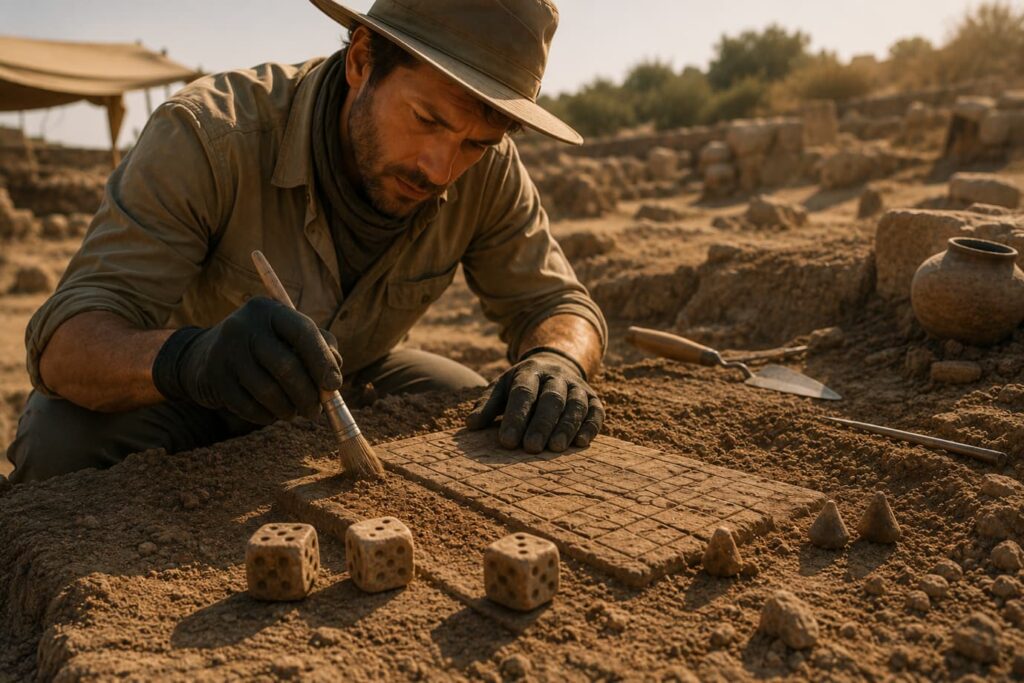
One of the most ancient recorded human urges is the wish to challenge fate by throwing an object. Written literature, organised sport, formal religion all came late to the mature forms they have today, yet people all over the ancient world were rolling dice long before any of them had reached their modern forms, and archaeologists have been spending the past two centuries trying to reconstruct how widespread that habit was.
The same competitive spirit that drove ancient players to the dice table is reflected in modern digital platforms. Jett Bet online casino brings that tradition forward through its official website, where registration allows users to visit JettBet online casino and sign in — a straightforward login process available across the United Kingdom and GB markets.
The fact that ancient gaming culture has been continuous with its modern counterparts is not merely a metaphorical one, but it is a fact that is consistent in human psychology and has been proven by archaeological evidence in numerous instances across civilisations that are not related.
The Oldest Dice Ever Found: Burnt City, Iran
The oldest dice ever found so far were found in Shahr-e Sukhteh -the Burnt City- in southeastern Iran. The set, which was dated to around 28002500 BCE, was discovered with a board game and game pieces, indicating a gaming kit, not a ritual or religious object.
The dice were crafted out of ebony and were designed in long rectangular shapes as opposed to the cubic shape of the modern ones. The fact that they were included in a burial setting suggests that the individual who was being buried was a person who valued gaming to the extent that it was important enough to be included in the afterlife, which informs the archaeologists as much about the social attitudes towards play as it does about the objects themselves.
The Burnt City discovery has determined that organised dice games are older than many of the cultural developments that were thought to have preceded them. Formal gaming, it seems, did not arise out of leisure – it may have aided its formation.
Ancient Egypt: Senet and the Role of the Die
Egypt created some of the most aesthetically appealing gaming artefacts in the ancient world. Senet a board game, which used throwing sticks as dice, was depicted in Egyptian tomb paintings as early as 3100 BCE and was included in the grave goods of Tutankhamun, who died circa 1323 BCE.
The throwing sticks of Senet were flat on one side and rounded on the other, and produced results depending on the number of flat or rounded faces that fell up. This two-sided randomisation mechanism was in use earlier than the multi-faced die but it fulfilled the same purpose, which was to bring randomness to a competitive system.
Mond online casino offers registration and login through its official website, giving players a direct route to give Mond casino a go and sign in — accessible to users across the United Kingdom and GB.
The appearance of Senet in funerary scenes developed over centuries as a simple game into a symbolic trip in the afterlife, where each square symbolized a step in the development of the soul. One of the more notable instances of the extent to which the culture of dice penetrated the life of ancient Egypt is the incorporation of gaming mechanics into religious cosmology.
Mesopotamia and the Royal Game of Ur
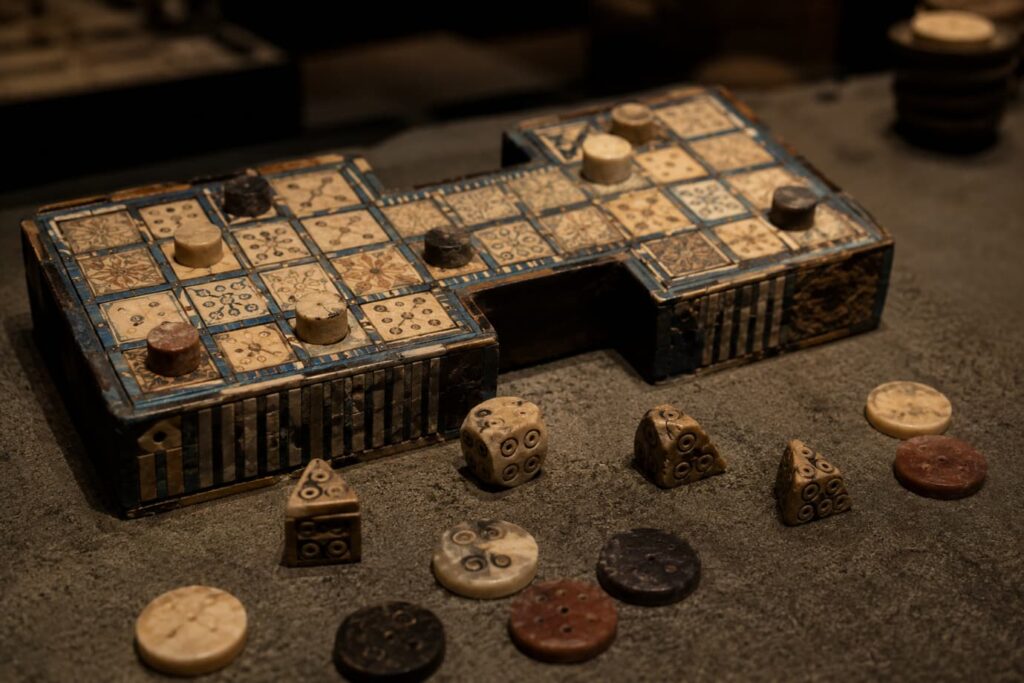
One of the greatest archaeological finds in the history of gaming was the Royal Game of Ur, which was found by Leonard Woolley in the royal tombs of the ancient Sumerian city between 1922 and 1934. The game is dated around 2600 BCE and has a unique board, playing pieces, and tetrahedral dice – pyramid-shaped objects with two marked corners that acted as binary randomisers.
In the 1980s, a Babylonian clay tablet in the British Museum was reconstructed as the rules of the Royal Game of Ur, and is one of the few ancient games that can be played today using the original rules. The game was a blend of strategy and luck in the ratios that would be identified by modern game designers.
The fact that it was found in royal burials in various locations in Mesopotamia proved that dice-based gaming was not exclusive to a particular social group. The game was also played in common domestic settings in versions, implying that it was a popular culture over centuries.
Rome, Greece, and the Democratisation of Dice
Dice were manufactured in vast amounts in classical antiquity. Bone and ivory cubic dice are always found in Roman excavations, many of them very similar in proportion and pip layout to the modern standard six-sided die. The Roman name of a dice player aleator provided the modern aleatory, meaning controlled by chance, which is still actively used in mathematics, music theory, and law.
Gambana online casino provides registration and sign in through its official website, making it easy to check out Gambana casino via a quick login — built for GB and United Kingdom players.
Dice gaming is recorded in Greek and Roman sources at all social strata, with soldiers playing knucklebones in military camps and aristocrats playing at special gaming tables. Emperor Augustus was a known lover of dice, and a number of Roman emperors passed laws, which tried, with little success, to limit gambling among the common people.
The loaded dice, or objects that have been intentionally weighted to give a particular result, have been found at archaeological sites throughout the former Roman Empire, and the desire to control the results of a game is as old as the games themselves.
What the British Museum’s Collection Tells Us
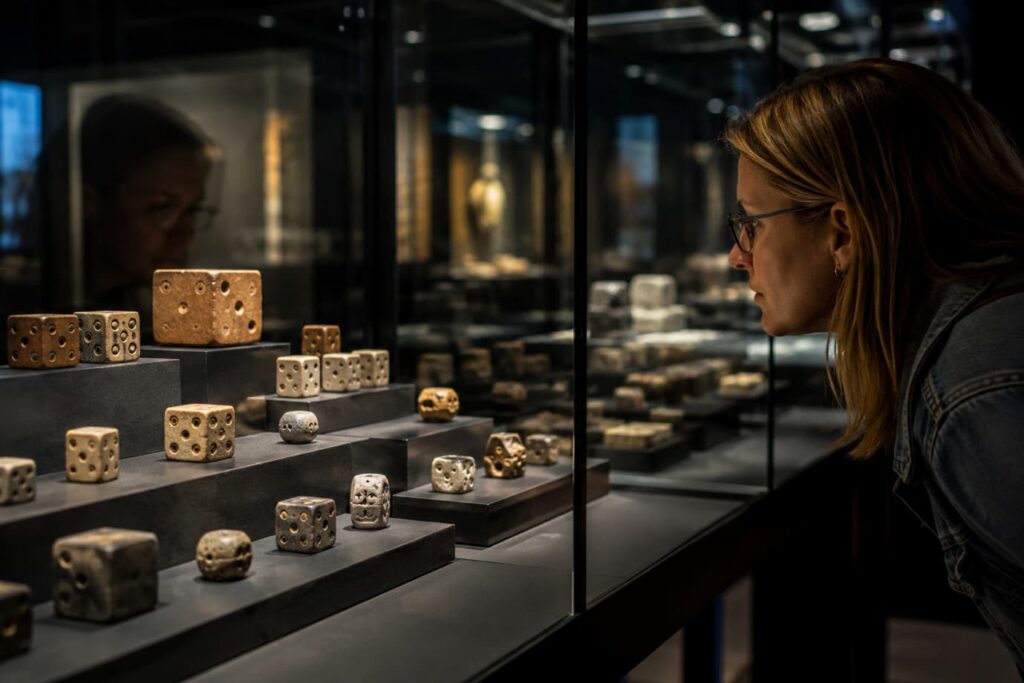
The range of gaming artefacts in large institutional collections makes it obvious that dice were used in practically all the contexts in which ancient people interacted with each other – a distribution pattern that cannot be explained by any purely ritualistic explanation.
According to the British Museum’s collection on ancient gaming, dice and board game artefacts recovered from Mesopotamian and Egyptian sites represent some of the oldest evidence of structured recreational play in human history.
The range of civilisations and centuries covered by the collection, with items found in domestic, military, religious, and funerary settings suggesting that gaming was not a marginal activity in the life of antiquity but a steady line that ran through it.
Why Dice Survived Every Civilisation That Used Them
The archaeological record does not indicate a single point of origin of dice gaming – it indicates parallel and independent evolution of cultures that were not in contact with one another. Dice are found in ancient India, China, Mesoamerica, and sub-Saharan Africa in forms and contexts that cannot have been of a common origin.
This independent invention is not common in material culture. It implies that the dice game responded to something in human thought that did not involve the transmission of culture to evolve – a necessity to externalise chance, to render fate visible and negotiable in an organised social environment.
The objects themselves, small, portable, durable, and instantly legible, were extraordinarily resilient. They outlived the fall of the civilisations that gave them birth, the substitution of the languages in which those civilisations spoke, and the metamorphosis of the religious systems which at times enclosed their use. A cubic die found on a Roman site and one bought in a modern store are functionally the same objects separated by two millennia of uninterrupted cultural use.
It is that continuity that makes dice games so distinctive as archaeological evidence. They are not monuments or texts, they are objects that people carried around, played with during normal times and were important enough to be buried with their dead.